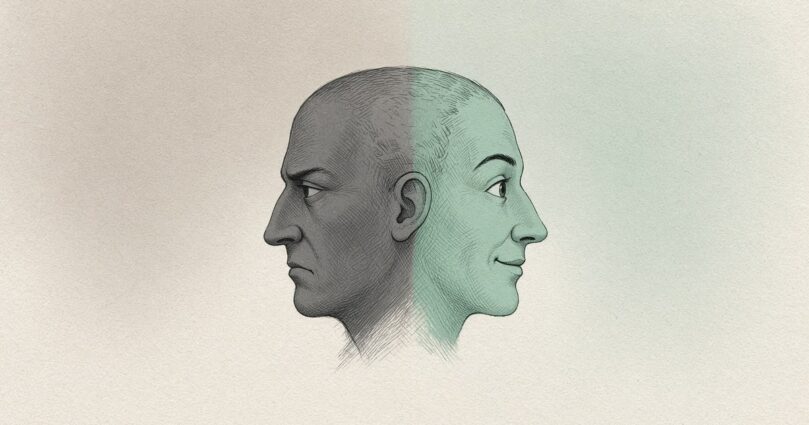
Orwell gave us the word. In Nineteen Eighty-Four, doublethink is “the power of holding two contradictory beliefs in one’s mind simultaneously, and accepting both of them.” The people doing it don’t recognise it as a contradiction at all.
I think the British left, whether it be the Greens or large parts of the Labour Party, is holding two such beliefs at once. This isn’t a post about whether either of them is right. Plenty of people are shouting about both, and I have no wish to join them.
The first is support for Palestine and, more broadly, for Islam and the Muslim communities of this country. That support extends to tolerance of practice. Sharia councils operate here (they have no legal force, and most of their work is religious divorce), and the separation of men and women in mosques and at some religious events is treated as a matter of faith rather than of equality. Much of traditional Islam draws a clear differential between men and women: different roles, different spaces and, in classical jurisprudence, different shares of an inheritance and different weight as a witness. Many Muslims would dispute that this amounts to the superiority of men. Few would say there is no differential at all.
The second is support for trans rights, and its sharpest edge is the changing room. The argument is over whether trans women, people born male who live as women, should be able to use women’s toilets and changing rooms. In April 2025 the Supreme Court ruled that “woman” in the Equality Act means biological sex. The Labour government said it accepted the ruling, though many in the party plainly didn’t like it. The Greens under Zack Polanski said Parliament should legislate instead to protect trans people. Either way, the instinct on the left is that a trans woman’s place is on the women’s side of the door.
One view holds that the difference between men and women is so fixed, and matters so much, that the two should be kept apart and treated differently. The other holds that the difference is either movable or matters so little that a person’s own sense of who they are should decide which side of the line they stand on. These aren’t two policies that happen to sit awkwardly together. They are opposite answers to the same question. What is a woman, and does it matter?
Isn’t it the ultimate doublethink to hold two fully contradictory thoughts in your head at the same time, and not see the contradiction?
Those who hold both would say there is no contradiction, because they endorse neither belief. What they defend is people. A Muslim woman has the right to her faith and a trans woman has the right to her identity, and what either of them believes about men and women is none of the state’s business. Tolerance isn’t agreement.
That is a coherent position, and it may well be the honest one for many people. It holds, though, only for as long as you don’t look at what is being tolerated. Look, and the two beliefs point in opposite directions. Both are claims about the same line between men and women. One says the line must be kept. The other says it can be crossed. You can defend a person’s right to believe either. It is harder to believe both.
It can’t hold for ever. Not looking only works until the two halves turn up in the same place, and sooner or later they will: a Muslim mother who doesn’t want her daughter undressing next to someone born male; a trans woman who wants her place on the women’s side of the mosque. Birmingham had a taste of it in 2019, when Muslim parents protested for weeks outside primary schools over lessons teaching children that LGBT families exist. The left found itself on both sides of the school gate at once.
At that point somebody has to choose. And the moment they do, half the coalition finds out what it has been tolerating, and the whole thing goes to hell in a handcart.
Perhaps there is a principle that reconciles the two beliefs and I haven’t found it. If there is, I would genuinely like to know what it is. If there isn’t, Orwell had a word for holding both, and for not noticing that you do.